

In Piazza della Signoria, right next to Michelangelo’s David replica by Luigi Arrighetti (installed in its exact spot in the piazza in 1910), stands a marble giant that the people of Florence once despised so much they covered it in hate poems and mocked it for weeks.
Unveiled in 1534, Baccio Bandinelli’s Hercules and Cacus was meant to proclaim Medici power but instead it became the target of one of the Renaissance’s most savage public roastings.
Over a hundred satirical verses were stuck to its base, and the artist even fled the city in shame.
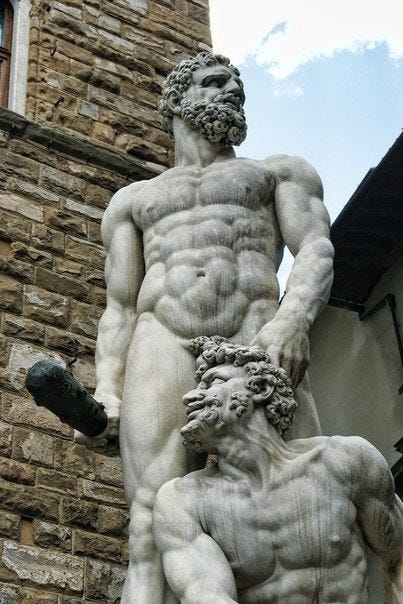
Carved from white Carrara marble, this over 5 meter-tall colossus captures the climactic moment of Hercules’ triumph over the fire-breathing cattle thief Cacus.
Commissioned under the restored Medici rule (specifically by Pope Clement VII and Duke Alessandro de’ Medici), it was meant as a powerful pendant to Michelangelo’s David (then still in the square), symbolizing physical might and just authority crushing rebellion.
The very marble block had originally been intended for Michelangelo himself back in 1508, but after the Medici’s return to power following the 1530 siege of Florence, it was confiscated from him (a man who had actively resisted them) and reassigned to Bandinelli, their loyal supporter.
In that sense, the sculpture itself became a political weapon: Hercules as the Medici regime, Cacus as anyone who dared challenge it.
Yet its unveiling sparked immediate fury.
Florentines hated it. Over 100 satirical poems were plastered to its base in the days after, mocking Bandinelli’s bulging, awkward musculature (one likened the forms to a sack of melons) and using the piece to attack the authoritarian Medici order it represented.
Duke Alessandro responded by jailing some of the poets, while Bandinelli, humiliated, fled temporarily to Rome.
Even contemporaries like Benvenuto Cellini and Giorgio Vasari dismissed it as inferior to Michelangelo’s genius.
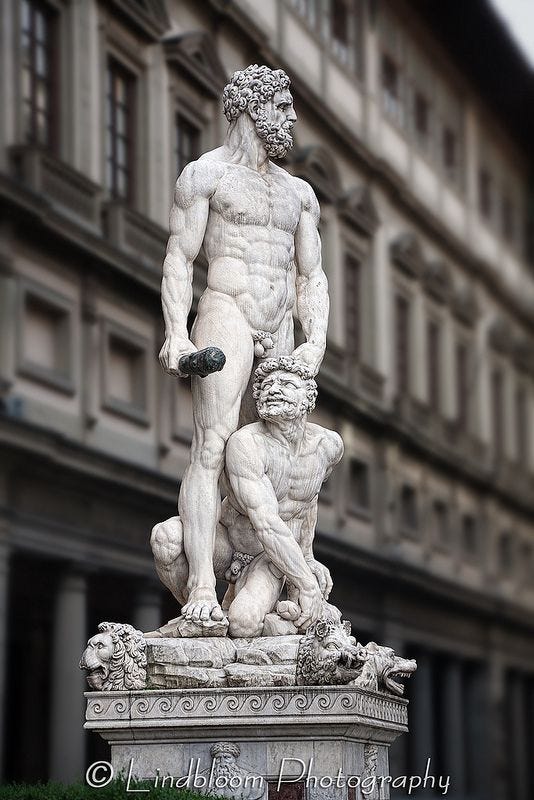
Bandinelli and Michelangelo weren’t exactly sending each other fruit baskets. They exchanged insults, fought for commissions, and took every chance to one‑up each other. This statue was Bandinelli’s attempt to prove he belonged in the same league. Whether he did or not depends on who you ask, but the tension between the two artists is part of what gives the piece its strange energy.
Despite (or perhaps because of) the controversy, it endured, surviving as a Mannerist statement of dominance in the very square where republican ideals once flourished.
It’s one of those works where the backstory is just as dramatic as the scene it shows. Power struggles, artistic jealousy, and public gossip, all frozen in marble, right at the front door of Florence’s old government building.
Thank you for being part of Cultural Canvas! If you love what we do, consider supporting us.
Stay inspired and see you in the next post!
Very interesting story. I have to admit I hate it too. It's characters are ugly, where Michelangelo produced beautiful work.
I feel like I would have been better off not reading...because I can feel the tension in my own joints; two rival artists competing for space with the government in the middle of the conflict. I can imagine what it must have been like to create something you couldn't easily relocate when backlash came or when you didn't agree with the owners of the space your creation would occupy. I'd be tempted to trash the statues, too.
This just reminds me of a rivalry I faced as kid. And, the other kid wasn't even much of an artist.